Pages

Showing posts with label history. Show all posts

Monday, September 18, 2017

Woolen Mill Trip

Mountain Meadow Woolen Mill is one of the few
mills that processes wool from the raw fleece to the
finished product of roving or yarn. 
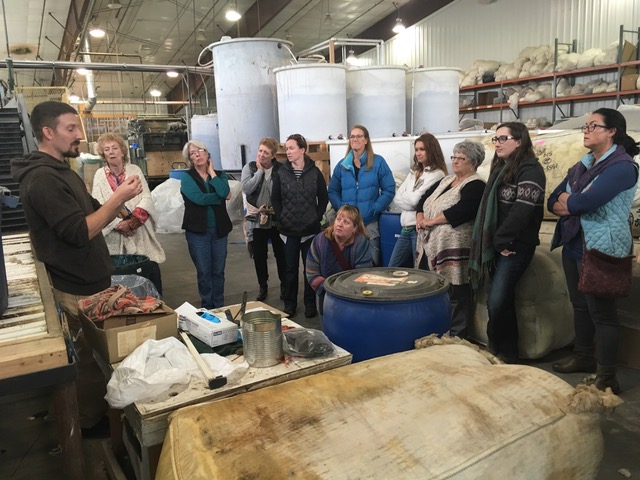
Guild members began the mill tour by learning some of the background
on how and why the mill was started ten years ago.
Mountain Meadow Woolen Mill, Buffalo, WY
September 16, 2017
The skirting process was explained 
Ben explained how the skirting process not only removes vegetable matter
but also short cuts that can occur during shearing 
wool grease is a by-product of the scouring process.
The equipment in the mill ranges in age and some machines
were manufactured and/or obtained overseas. The machines
 often came without instruction manuals or the instructions
were in Spanish or Portuguese. The mill had to be innovative
to get the machinery running.
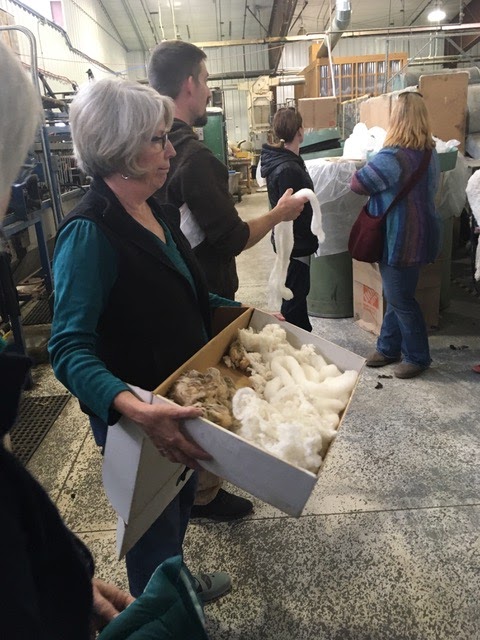
The wool is sent through drum carders as well as
pin drop machines to make sure the wool fibers
are parallel. Guild members were able to feel the
difference between the processes from the samples
shown in the box
The pin drop machines have fine combs that separate
the wool fibers. The wool is put through the process
several times. 
The wool is guided through a pin drop machine
drum carders
spinning the wool onto bobbins
one of the many boxes of wool being spun into yarn at the spinning machine
The spinning machine was turned on during our Saturday visit, and Ben demonstrated how quickly a broken strand could be repaired.

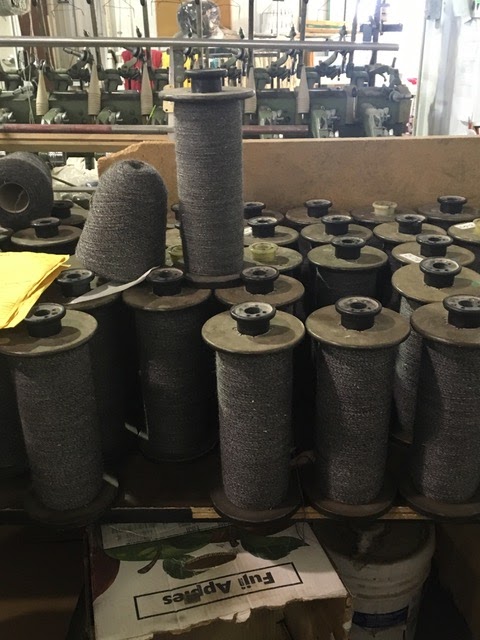
Large bobbins filled with yarn
Once the yarn is on the bobbin, it is skeined and then
wrapped on cones.
This machine wraps the yarn from a skein onto a cone
Some of the yarn is also dyed at the mill, and the
mill store has many gorgeous skeins for sale.
Buyers can also purchase roving from a variety of
sheep or exotic breeds. 
Finished wool items are also for sale (sweaters, hats,
mittens, throws) in the mill shop

The owners and founders of Mountain Meadow Wool share their story in the following video.


Tuesday, September 5, 2017

Eleanor Roosevelt - a Knitter

source
Knitty magazine (Winter 2009) featured a vintage mitten pattern reworked by Franklin Habit. The original pattern was in Eleanor Roosevelt's handwriting.

Mrs. Roosevelt was an avid knitter and carried her knitting with her everywhere. In her autobiography, Mrs. Roosevelt writes that when she was five or six, her nurse cut holes into the socks she had knit so that she would learn how to darn heels properly.

The article and pattern can be found here.

Other information about Mrs. Roosevelt's knitting can be found in this Interweave post.


Monday, July 24, 2017

Knitting and Espionage

source
Interweave recently shared a fascinating article on the role knitting has played in history, especially through espionage. The article is below:

Since knitting was a very common sight, nobody would think of knitting as a suspicious activity. But knitting and espionage have a certain connection throughout history.

Let’s go way back to the Revolutionary War in the United States. As British troops took over the homes of colonials during the war, these people became less than pleased. One such dissatisfied rebel was Molly “Mom” Rinker of Philadelphia. Troops quartered themselves in her house and did not allow the men of the household into the dining area, but Molly was allowed in to serve the troops. It was here that she listened closely to their conversations. She would then write the information down on a small piece of paper, wrap it around a stone, and wrap yarn around the stone until she had a very normal-looking ball of yarn. She would take this yarn ball to a rock overlooking some woods. There she would sit and knit, dropping the ball of yarn off the rock and into the woods below without notice. One of George Washington’s men would ride by and grab the yarn to learn British military secrets.

During World War I, another yarn-equipped informant helped the Allies. A Frenchwoman named Madame Levengle would sit in front of her window and knit. As she knitted, she would watch troop movements from the window and tap her feet on the floor to send codes to her children pretending to do schoolwork on the floor below. The children would write down the codes, and all went unnoticed by nearby German marshals the whole time.

In World War II, an infamous American spy named Elizabeth Bentley used knitting to disguise her espionage as well. She ran two spy rings that sent damaging information about the United States to the Soviet Union, and she would sneak documents to the Soviets in her knitting bag.

Phyllis Latour Doyle was a secret agent for Britain during WWII. She parachuted into Normandy in 1944 and chatted with German soldiers, acting as a friendly helper. But then she knitted messages to the British, which they translated using Morse Code. Knitting coded messages is a form of steganography, which is a way to physically hide messages. A specific combination of knit and purl stitches could be translated into messages.

While knitting coded messages was less common than using knitting to disguise suspicious activity, codes in knitting were still a threat. The Belgian Resistance during World War II recruited women who had windows overlooking railway yards. They were to note the German train movements with their knitting: Purl one for one type of train, drop one for another. During World War II, the Office of Censorship in the United States banned people from posting knitting patterns abroad, since the instructions could in fact disguise military secrets.

Next time you suspect someone might not give knitters the respect they deserve, make sure to set them straight with the radical history of wartime knitters!

More information about knitting as an espionage tool can be found here.


Friday, June 30, 2017

3,000 year old yarn

source
The ball of yarn shown at left is 3,000 years old. For much of its existence, it has been buried underground, in boggy land, along with the rest of the remains of three small houses built millennia ago, near what’s now Cambridge, England.

Ever since archaeologists discovered Must Farm, which has been called Britain’s Pompeii, they have been uncovering small clues as to what life was like for the families that lived here. This ball of yarn is one of the most delicate finds–extraordinary in its survival over all these years.

In the week since the yarn was first found (July 2016) the team has carefully cleaned it up. “Excavating and cleaning artifact this fragile is not easy but seeing them up close like this really shows how remarkable these finds are,” the team wrote on their Facebook page.

Friday, June 2, 2017

Yarn Bombing History

Yarn-bombing has become a world-wide phenomenon. The knitter who started the craze shares the reason behind the creative movement in a short video on TED talks.

Textile artist Magda Sayeg transforms urban landscapes into her own playground by decorating everyday objects with colorful knit and crochet works. These warm, fuzzy "yarn bombs" started small, with stop sign poles and fire hydrants in Sayeg's hometown, but soon people found a connection to the craft and spread it across the world. "We all live in this fast-paced, digital world, but we still crave and desire something that's relatable," Sayeg says. "Hidden power can be found in the most unassuming places, and we all possess skills that are just waiting to be discovered."

The five-minute video can be seen here.


Thursday, August 4, 2016

How the West was Wooled

Twist Collective published a three-part history of How the West was Wooled. It's an interesting read.

Part One - bringing sheep to the West

Part Two - marketing and using wool

Part Three - the return of wool