Pages

Showing posts with label wheel spinning. Show all posts

Thursday, October 5, 2017

Spinning Gradient Yarn

source
From Interweave: "I am the boss of my yarn! I can blend colors! I can change from one fiber to another in the same skein of yarn! I can spin gradient yarn from any old fibers! But sometimes being the boss is too much work. Sometimes you want the fiber to do the work for you. You want to spin gradient-dyed fiber.

There are more ways than you might think to spin gradient yarn that preserve the color progression."

Interweave shares the four easiest ways to spring gradient yarn in this post


Tuesday, September 12, 2017

Long Draw Spinning Tips

source
Spinning long draw is a great way to create light, soft, fluffy yarn. As you spin, air is trapped between the fibers, which creates a warm, nicely insulating yarn. Long draw spinning can be a bit frustrating at first, because you need to manage your fiber and twist a little differently than in short draw spinning, but it’s a lovely method once you get your rhythm down. 


Thursday, August 24, 2017

Show and Tell - August

Laura B. brought some Cheviot roving she purchased in Durango as well
as a bobbin of handspun from the roving. Laura knit the lacy shawl
form handspun for a friend. 
Colleen J. shows the needle-felted picture she is working on. She took
a class in Durango recently on the technique. After felting, the piece
is to be wet-felted. Colleen is also knitting a shawl.
Jeni V. has been sewing: she constructed a large project bag with removable
sections. Jeni also brought three shawls to show the members.
Sandy W. has been spinning, and she recently took a silversmithing class
and made a ring. Sandy showed the members the sweater she entered in
the county fair. She knit the sweater with her own handspun. The pattern
is on Ravelry and is called Spring Showers
Sue O. crocheted a purse using ribbon yarn.
Sali A. modeled the poncho she knit from her handspun scraps


Friday, March 31, 2017

How to Ply Yarn

source
A plied yarn is stronger, more consistent, and more stable than the singles from which it is made. Also, in the ply structure, more of the individual fibers are covered and protected from abrasive wear, light and chemical damage. Whether you’re learning for the first time, want to weigh the benefits of single- vs. multiple-ply yarn, or want tips for plying on a drop spindle, Interweave's free eBook is packed with helpful tips for spinners of all skill levels.

The book contains tips from Maggie Casey, Judith MacKenzie, Rita Buchanan and other spinning masters. The free eBook contains a wealth of information for the beginning spinner and experienced spinner.

Monday, November 21, 2016

Tackle those UFOs

Weavers, spinners, quilters, crocheters, knitters - work on a variety of projects, and from time to time some projects become stalled or are forgotten.

Let's be honest: we all have unfinished projects (UFOs) tucked away in bags, boxes, and baskets. It might be time to come up with a plan to tackle them and to gain some room in your closets or project bags. You may want to find a new home for some projects, salvage supplies from another, and finally complete those that you love.

McCall's Quilting's blog published a strategy to deal with Projects in Bags, and maybe it will give you the nudge that you need.


Wednesday, November 9, 2016

Handspinning Video

Enjoy this creative look at the Revolution of Handspinning. The characters and background are  needle-felted, and it's fun to watch.


Tuesday, July 19, 2016

Spinning with Plastic

source
Plastic is not a natural fiber, but it can be turned into yarn for knitting and crocheting and weaving.

Michelle Baggerman who lives in the Netherlands has created many projects from grocery store plastic bags - a craft she calls 'Precious Waste.' Michelle weaves with the recycled "yarn" that she spins. 

An interview with Michelle Baggerman can be found on the Crafts from the Cwtch. A video of Michelle spinning the plastic yarn is at the end of the post. 


Tuesday, February 16, 2016

Long Draw Spinning

source
According to the Craftsy blog, spinning long draw is a great way to create light, soft, fluffy yarn. As you spin, air is trapped between the fibers, which creates a warm, nicely insulating yarn. Long draw spinning can be a bit frustrating at first, because you need to manage your fiber and twist a little differently than in short draw spinning, but it’s a lovely method once you get your rhythm down. You can spin long draw with wool, silk, alpaca and other types of fibers.

Craftsy's photo tutorial found here demonstrates the technique of Long Draw spinning with wool.


Thursday, December 10, 2015

Bedazzle Your Spinning

source
"Mom" on Simply Notable shares how she added beads to her spinning. While her technique is explained using a drop spindle, it may be possible to adapt it for other types of spinning as well.

I hope someone will try this idea and share the results at a Fiber Guild meeting.

Information on this technique can be found here.

Monday, October 5, 2015

Kylie S. - Young Spinner

Kyle S.
September 26, 2015
 Nine-year old, Kylie S. is the youngest member of the Guild and often shows the items she has knit during the Show and Tell segment of the meetings.

Maggie Casey gives Kylie S. some suggestions.
Kylie and her mom (Sabrina) are new spinners, and both attended the full day of spinning instruction with Maggie Casey on Saturday.

Thursday, October 1, 2015

Navajo Plying - Professional Development

Maggie Casey demonstrates Navajo plying
Riverton, WY
September 26, 2015
It suddenly got quiet in the room when Maggie Casey began to demonstrate the process of Navajo plying, which creates a three-ply yarn.

Navajo plying 
Dawn P. wanted a closer look at the process of Navajo plying.

Wednesday, September 30, 2015

American & English Longdraw - Professional Development

Vicky B., Brianna F., Salli A., Colleen J., Dawn P, and Cinde P. prepare cotton bolls for
spinning to learn how to spin with short fibers. 
Saturday afternoon, nine spinners learned the difference between American and English Longdraw and how the techniques can be used with different fibers.

By holding on to the seed in the cotton, spinners were able to spin the
short cotton fibers on to their yarn. 
 Maggie Casey gave each participant a cotton boll and showed them how to fluff the cotton fiber, hold on to the see within it, and spin the short cotton fibers. By working with cotton, students could see how they might use the technique when spinning with other short fibers like cashmere.

Sandy W. and Sabrina S. prepare some yarn
for a lesson. 
Spinning participants display their yarn
Dawn P., Salli A., Colleen J., Sandy W., Maggie Casey, and Cinde P.
Kris P., Kylie S., Brianna F., Sabrina S., and Vicky B.
Not pictured: Laura B.
Riverton, WY
September 26, 2015

Tuesday, September 29, 2015

Boucle Spinning - Professional Development

Saturday morning's class was eager to learn a new technique.
September 26, 2015
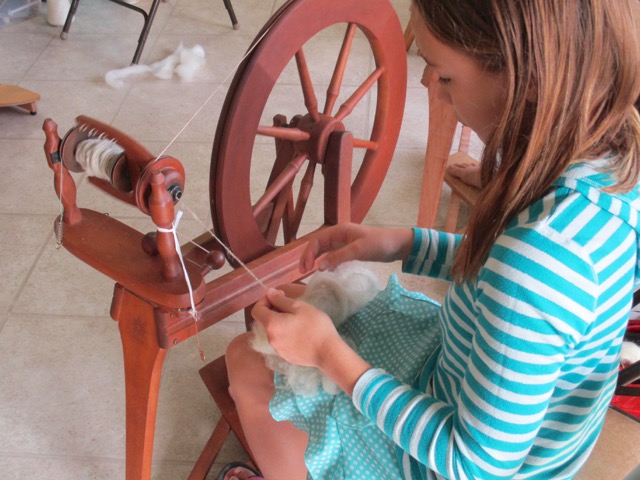
Saturday morning, nine spinners brought their wheels for the second day of classes with Maggie Casey. The morning class spun two fibers together (merino and adult mohair) to create a boucle yarn.

Sandy W., Sabrina S., Kylie S., and Vicky B. first spin with merino
Riverton, WY
September 26, 2015
Salli A., Laura B., Colleen J., and Dawn P. prepare their first assignment
to spin a length of merino roving. 
First the students spun a section of merino and then added the mohair.

Colleen J.  
Laura B. begins the process of "abusing" the yarn
 to create the boucles.
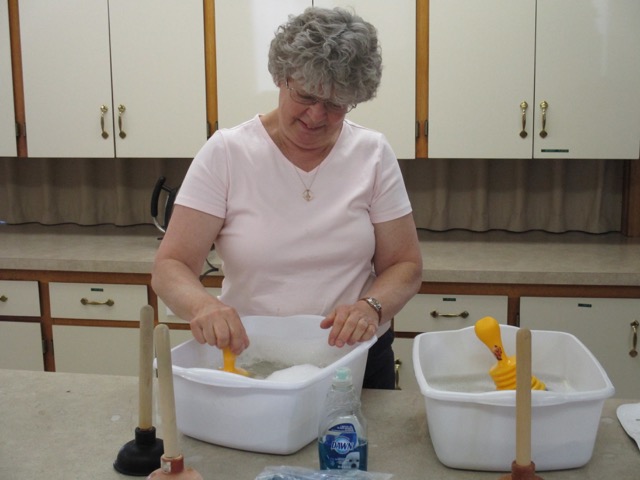
Once the spinners had a length of merino and mohair spun, then they headed to the kitchen. The sample hanks were submerged into very hot water with dish soap and used sink plungers to agitate the wool. After a time, the yarn was then plunged into ice water to force the fibers to shrink; thus, causing the mohair to create the boucle loops. The process was repeated at least twice.

Vicky B. whacks her yarn on the kitchen counter.
The final step in the process was whacking the yarn against the kitchen counter or on the railing outside the building. The "abused" yarn became curly boucle.