 |
| source |
Showing posts with label yarn. Show all posts
Showing posts with label yarn. Show all posts
Monday, April 30, 2018

Tuesday, April 24, 2018
12 Yarn Ball Types
 |
| source |
Monday, February 19, 2018
Unique Fiber - Bear
 |
| source |
Interweave recently reposted an article about Maxine Tyler: Official Bear Knitter.
Friday, February 9, 2018
Organizing Yarn Stash
 |
| source |
Look around you; do you see random skeins of yarn tucked here and there? Do you have baskets overflowing with patterns, yarn and notions?
To organize your yarn and stop the stash creep from taking over your house, check out Lion Brand's blog post for some amazing suggestions from real Lion Brand crafters, including photos of storage ideas. The article takes you through step by step, providing plenty of tips along the way.
Wednesday, January 24, 2018
There's a Knot in My Yarn!
Very Pink Knits demonstrates how to work with an unexpected knot in a skein/ball of yarn.
Wednesday, January 17, 2018
Spinning Yak Using Supported Longdraw
According to Stephanie Flynn-Sokolov, "To spin yak, you will need a wheel with a very high drive wheel to whorl ratio. One way to achieve this is with a very big drive wheel. Down fibers like camel, yak and bison yearn to be spun longdraw. The supported longdraw seems to work best for me. Using this drafting technique may require some practice if your default drafting is a short draw, forward or back. After attaching the fiber to your leader you will be gently controlling the twist with your forward hand. Your fiber supply hand cups the fiber while allowing a small amount of fiber between your thumb and forefinger. Since the fiber is fine, we will be spinning a fine yarn, and since the fiber is so short the drafting triangle is microscopic in comparison to a medium weight wool yarn. In the drafting triangle your fiber supply turns into yarn, so the more fiber you feed in, the heavier your yarn. Pull your fiber supply hand away from your forward hand while using your forward hand like a stop gate to open, shut, twist and untwist the twist between your hands allowing only enough twist through to twist those tiny fiber in the triangle between your forefinger and thumb on your fiber supply hand. Then treadle, open the front hand finger and thumb and let the yarn draw on."
Monday, January 8, 2018
Yarn Balls

Adding some splashes of color to your winter is as easy as creating some airy "yarn balls" to place in a basket or simply arrange on the table.
Sally Reese explains the easy process on P&G everyday.
Friday, November 10, 2017
Patterns for Mini Skeins
 |
| source |
Over the Rainbow complied patterns on Ravelry in a Favorites board called "Fade" that may provide just the inspiration you need.
Thursday, November 9, 2017
What Do You Call That Color?
 |
| source |
Wednesday, November 1, 2017
Spinning Heather & Tweed Yarn
 |
| source |
Jillian Moreno, editor of Knittyspin, discusses and illustrates the difference between Heather and Tweed yarn in the Knittyspin Deep Fall 2017 article: Heather or Tweed.
Tuesday, October 31, 2017
Create Gradient Yarn w/o Spinning
 |
| source |
Check out the tutorial on the Louet blog post: Make a Custom Gradient Yarn
Monday, October 23, 2017
Pingora Yarns
 |
| Carrie J. (owner of Pingora Yarns) Lander, WY October 2017 |
Carrie has stocked the store with a nice selection of natural fibers - many from the Rocky Mountain region.
 |
| large display room filled with colorful yarn |
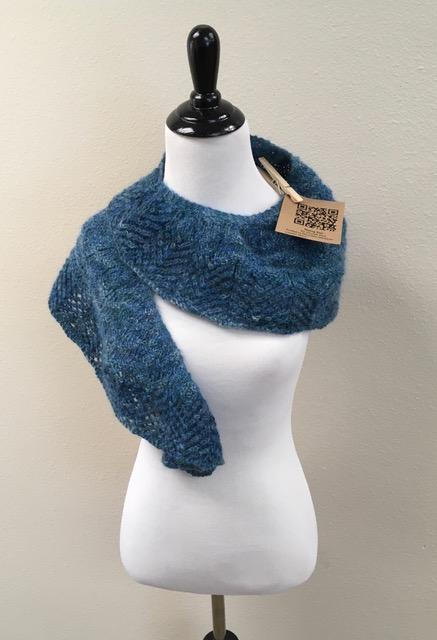

Tags clipped to the samples give pattern information.

 |
| bulky yarn in a wide range of colors |
 |
| yarn on the wall pegs are from the Rocky Mountain region |
 |
| needles and hooks in many sizes and types |
 |
| notions for knitters and crocheters |

 |
| Plans are being made for the shop's tree to be yarn bombed. Ask Carrie how you can be a part of the project. |
Thursday, September 28, 2017
Weigh & Estimate Yarn
 |
| Add caption |
Instead grab a food or postal scale and weigh the yarn. It’s the easiest way to figure out how much yarn you have left. It’s also a fantastic method to make sure you have enough yarn when you’re trying to work from your stash.
Craftsy explains the easy steps in this post.
Monday, September 4, 2017
Yarn Organization
 |
| source |
Her free, printable organizer cards can be found here.
Tuesday, August 29, 2017
Adding Twist to Splitty Yarns
 If you're finding it difficult to work without splitting stitches, it might be worth changing the direction that you wrap the yarn around the needle. It's not quite that straightforward: if you switch to wrapping the yarn anti-clockwise (as in the Eastern style) then you also have to knit into the back of those stitches when you come to work them to avoid making twisted stitches.


Learn more about this technique on YarnSub
Friday, June 30, 2017
3,000 year old yarn
 |
| source |
Ever since archaeologists discovered Must Farm, which has been called Britain’s Pompeii, they have been uncovering small clues as to what life was like for the families that lived here. This ball of yarn is one of the most delicate finds–extraordinary in its survival over all these years.
In the week since the yarn was first found (July 2016) the team has carefully cleaned it up. “Excavating and cleaning artifact this fragile is not easy but seeing them up close like this really shows how remarkable these finds are,” the team wrote on their Facebook page.
Friday, June 16, 2017
Calculating Remaining Yards in a Skein
 |
| source |
Interweave Yarn Hacks prepared a tutorial in a recent post that answers the question.
Calculate the Remaining Yards in a Skein
Friday, May 26, 2017
Intentional Pooling
 |
| source |
Marly Bird has been doing a lot lately with planned pooling in crochet, but the same kind of thing works in knitting, too.
Crafty Crusader wrote a post a while back about using planned pooling in a hat project, which pointed me to the Planned Pooling website. This site allows you to plug in colors and note how many stitches are worked in each color as well as how many stitches are in a row and whether it’s worked flat or in the round.
This allows you to see what a knit up swatch or garment would look like, and you can play with the numbers to get different effects." ~ Sarah White, Craft Gossip site
Friday, May 19, 2017
Eco-Friendly Fibers - a review
 |
| source |
Interweave reviewed a handful of high-quality, certified organic yarns in this post.
Thursday, April 27, 2017
Yarn Joins
 |
| source |
Why know try all of the methods and find one you like best.
Subscribe to:
Posts (Atom)