Pages

Showing posts with label wool. Show all posts

Thursday, May 10, 2018

Sheep Days - Demonstration

Sali A. and Cinde P. set up their spinning wheels
at the Pioneer Museum for Sheep Day
April 2018
(photo by Sandy W.) 
Cinde P. shows children how the wool from sheep is turned into yarn
and then into cloth or clothing
Sheep Day - Pioneer Museum in Lander, WY
April 2018
(photo by Sandy W.)
Sali A. answers questions from the children who
watched her spin at the Pioneer Museum
in Lander, WY on Sheep Day
April 2018
(photo by Sandy W.)

Another photo was shared in an earlier post

Tuesday, March 27, 2018

Dyeing Sources


As the weather begins to transition into Spring, we become impatient to have more color in our surroundings. Satisfy those cravings by dyeing some yarn or fiber.

Robyn Spady complied links and information to make the process easy and successful.

Friday, February 23, 2018

Conservation Breed Wool

source
According to the Woolery, "Part of the fun of working with wool is that there are so many unique varieties of sheep. Wool from different breeds work better for different projects and having a choice is fun. In order to make sure we have choices in our wool fibers for the future, we need to work on conserving rare sheep breeds. Choosing to work with Conservation Breed Wool helps support the farmers and organizations who are working hard to preserve these breeds."

Learn more about the rare and native breeds in the Woolery's post,  Conservation Breed Wool.


Thursday, December 7, 2017

Using Hand Carders

source
Interweave's free wool combing and carding eBook shows spinners how to get the most out of their fiber combs and cards and how to get beyond commercially prepared fiber by trying new methods and a variety of wool carding tools. 

The free eBook can be found here.

Wednesday, November 22, 2017

Weaver's Guide to Wool Yarn

source
Liz Gipson at Yarnworker gives weavers some valuable information on selecting wool for weaving. She reminds weavers that most of the yarn rules regarding looms apply to looms with shafts. Those rules may not apply to the rigid heddle weaver since this loom doesn’t put as many demands on the yarn.

She states that in general, using the simple pinch and pull test will allow a weaver to determine if yarn is strong enough for warp. Virtually any yarn can be used for weft, however, weavers still may want to consider how well it will wear over time and under the rigors of its intended use.

Liz's post, A Weaver's Guide to Wool Yarn, is a good source for rigid heddle weavers. 


Monday, November 20, 2017

Faces of Merino - Part II

source
An earlier post discussed why merino is the most popular type of wool for crafters.

Part II of the Faces of Merino, reveals why the merino fiber is so special.

Part I can be found here


Thursday, October 26, 2017

Wool Ornament

source
The holiday season is quickly approaching.

If you need a quick gift for friends or family, Riley Blake Designs can help you turn bits of wool into an adorable ornament or a personalized gift tag.

Wednesday, October 25, 2017

Brown Sheep Yarn Company

source
What’s not to love about locally sourced wool, spun and dyed at a family-owned mill, using environmentally friendly methods? 

Go behind the scenes at Brown Sheep Yarn Company with Amy Palmer in the Interweave article: American Wool from the Great Plains: Brown Sheep Yarn Company.

FYI - you can see and purchase Brown Sheep Yarn at the newly opened Pingora Yarns in Lander, WY


Tuesday, October 24, 2017

Faces of Wool

source
Merino is most likely the first breed you think of when you think of sheep, and it’s probably the only breed non-crafters could name. Merino is also the most popular type of wool for knitters, crocheters, spinners, and crafty types of all stripes. Interweave's article explains why these sheep are so special. 


Wednesday, October 11, 2017

Wyoming Wool Industry

source
The Wyoming Wool Industry has an interesting history and is shared on the Wyoming Wool Growers' Association website

As Guild members, we should support the local industry as much as we possibly can by purchasing local wool products or by helping to promote the industry.

Wyoming Wool Growers - FaceBook page


Monday, September 18, 2017

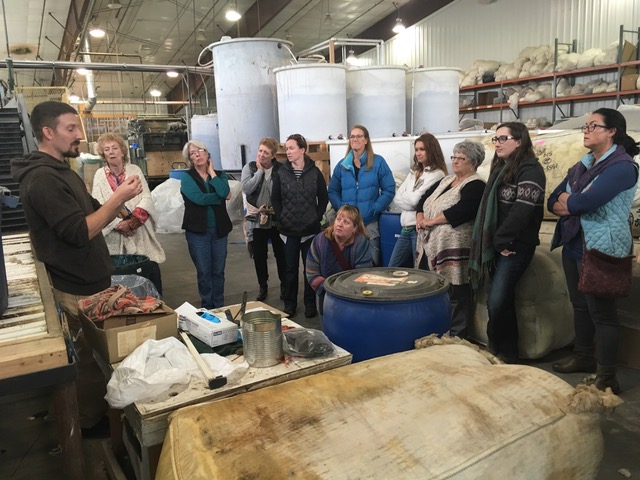
Woolen Mill Trip

Mountain Meadow Woolen Mill is one of the few
mills that processes wool from the raw fleece to the
finished product of roving or yarn. 
Guild members began the mill tour by learning some of the background
on how and why the mill was started ten years ago.
Mountain Meadow Woolen Mill, Buffalo, WY
September 16, 2017
The skirting process was explained 
Ben explained how the skirting process not only removes vegetable matter
but also short cuts that can occur during shearing 
wool grease is a by-product of the scouring process.
The equipment in the mill ranges in age and some machines
were manufactured and/or obtained overseas. The machines
 often came without instruction manuals or the instructions
were in Spanish or Portuguese. The mill had to be innovative
to get the machinery running.
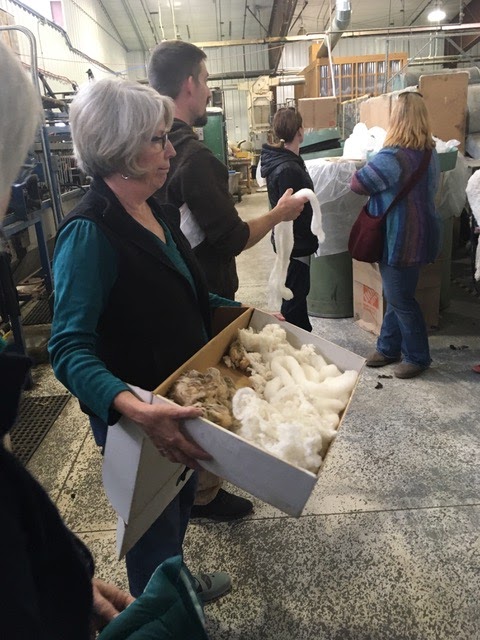
The wool is sent through drum carders as well as
pin drop machines to make sure the wool fibers
are parallel. Guild members were able to feel the
difference between the processes from the samples
shown in the box
The pin drop machines have fine combs that separate
the wool fibers. The wool is put through the process
several times. 
The wool is guided through a pin drop machine
drum carders
spinning the wool onto bobbins
one of the many boxes of wool being spun into yarn at the spinning machine
The spinning machine was turned on during our Saturday visit, and Ben demonstrated how quickly a broken strand could be repaired.

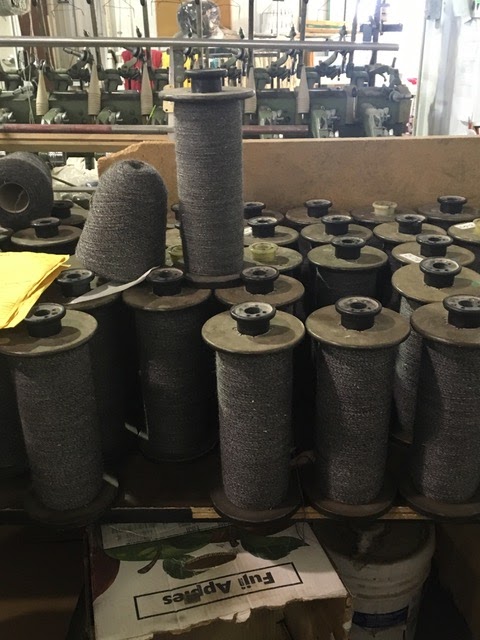
Large bobbins filled with yarn
Once the yarn is on the bobbin, it is skeined and then
wrapped on cones.
This machine wraps the yarn from a skein onto a cone
Some of the yarn is also dyed at the mill, and the
mill store has many gorgeous skeins for sale.
Buyers can also purchase roving from a variety of
sheep or exotic breeds. 
Finished wool items are also for sale (sweaters, hats,
mittens, throws) in the mill shop

The owners and founders of Mountain Meadow Wool share their story in the following video.


Friday, June 30, 2017

3,000 year old yarn

source
The ball of yarn shown at left is 3,000 years old. For much of its existence, it has been buried underground, in boggy land, along with the rest of the remains of three small houses built millennia ago, near what’s now Cambridge, England.

Ever since archaeologists discovered Must Farm, which has been called Britain’s Pompeii, they have been uncovering small clues as to what life was like for the families that lived here. This ball of yarn is one of the most delicate finds–extraordinary in its survival over all these years.

In the week since the yarn was first found (July 2016) the team has carefully cleaned it up. “Excavating and cleaning artifact this fragile is not easy but seeing them up close like this really shows how remarkable these finds are,” the team wrote on their Facebook page.

Tuesday, June 13, 2017

Buying Sheep Fleece

source
If you're tempted to purchase a fleece online for spinning, check out the helpful advice on this Interweave post.

The article explains the topics to consider (weight, lock, ping, breaks, color, stains, vegetable matter, and skirting) before making the purchase.

Monday, June 12, 2017

Breaking in New Handcards

Add caption
Most handcards don’t come with operating instructions. Even under ideal conditions spinners face a learning curve to creating the airy rolags coveted for woolen spinning, but maybe there should be a warning label on new handcards: “Failure to break in handcards may lead to frustration when operating!” To make carding easier from the start, two carding experts offer tips for breaking in new handcards in this Interweave article.

Tuesday, June 6, 2017

Four Dyeing Methods

source
Those who participated in the Guild Spring Retreat enjoyed the process of dyeing wool with Kool-Aid and food coloring. 

Dye Your Yarn provides directions on over-dyeing wool on the stove, in the microwave, in gradients, and by dip dyeing. Check out the tutorials on their website

Wednesday, May 24, 2017

Colorful Assortment

An assortment of yarn dyed at the Spring Retreat in early May and some
items knit with the wool, dyed with Kool-Aid and food coloring.
The class was taught by Briana F.


Tuesday, May 9, 2017

Spring Retreat - Latch Hook Chair Pads

click to enlarge
Saturday, several guild members met at the Frank B. Wise Business Plaza in Fort Washakie for a afternoon class on making chair pad with wool roving and a crochet hook. Maia Rose was the instructor and provided the mesh base and the roving for the pad. Participants folded the edge of the mesh and using a "G" or "H" crochet hook began by securing the top edge before adding the roving into thick poofy rows.

Everyone went home with at least two inches completed on their 16 inch chair pad.

Monday, May 8, 2017

Spring Retreat - Dyeing

click to enlarge

Saturday, several guild members met at the Frank B. Wise Business Plaza in Fort Washakie for a morning class on dyeing wool with Kool-aid and food coloring. Briana Franks, the instructor, was assisted by Sandy Watkins. They prepared the small hanks of yarn and the supplies for the class of ten individuals and allowed the members to experiment and play with the colors.

Members experimented with several methods of dyeing: hand-painting, immersion, and dip-dyeing.

The dyed wool was steamed in crock pots, and some were finished in the microwave.

Thursday, April 27, 2017

Yarn Joins

source
The Yarn Sub website offers ten methods of joining yarn.

Why know try all of the methods and find one you like best.