Pages

Showing posts with label fiber. Show all posts

Friday, May 11, 2018

Alternative Fibers

source
Spinning Daily offers a free ebook for spinners that explains some alternatives to spinning wool: 


Wednesday, January 17, 2018

Spinning Yak Using Supported Longdraw


According to Stephanie Flynn-Sokolov,  "To spin yak, you will need a wheel with a very high drive wheel to whorl ratio. One way to achieve this is with a very big drive wheel. Down fibers like camel, yak and bison yearn to be spun longdraw. The supported longdraw seems to work best for me. Using this drafting technique may require some practice if your default drafting is a short draw, forward or back. After attaching the fiber to your leader you will be gently controlling the twist with your forward hand. Your fiber supply hand cups the fiber while allowing a small amount of fiber between your thumb and forefinger. Since the fiber is fine, we will be spinning a fine yarn, and since the fiber is so short the drafting triangle is microscopic in comparison to a medium weight wool yarn. In the drafting triangle your fiber supply turns into yarn, so the more fiber you feed in, the heavier your yarn. Pull your fiber supply hand away from your forward hand while using your forward hand like a stop gate to open, shut, twist and untwist the twist between your hands allowing only enough twist through to twist those tiny fiber in the triangle between your forefinger and thumb on your fiber supply hand. Then treadle, open the front hand finger and thumb and let the yarn draw on."

More information on spinning with Yak can be found on the Schacht Spindle Company blog.

Thursday, December 7, 2017

Using Hand Carders

source
Interweave's free wool combing and carding eBook shows spinners how to get the most out of their fiber combs and cards and how to get beyond commercially prepared fiber by trying new methods and a variety of wool carding tools. 

The free eBook can be found here.

Monday, September 18, 2017

Woolen Mill Trip

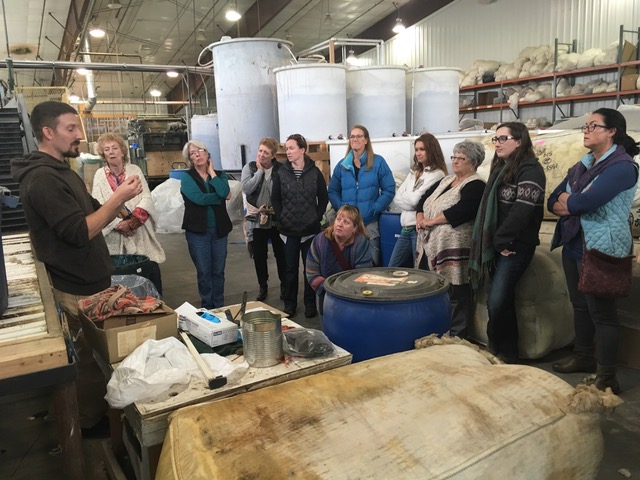
Mountain Meadow Woolen Mill is one of the few
mills that processes wool from the raw fleece to the
finished product of roving or yarn. 
Guild members began the mill tour by learning some of the background
on how and why the mill was started ten years ago.
Mountain Meadow Woolen Mill, Buffalo, WY
September 16, 2017
The skirting process was explained 
Ben explained how the skirting process not only removes vegetable matter
but also short cuts that can occur during shearing 
wool grease is a by-product of the scouring process.
The equipment in the mill ranges in age and some machines
were manufactured and/or obtained overseas. The machines
 often came without instruction manuals or the instructions
were in Spanish or Portuguese. The mill had to be innovative
to get the machinery running.
The wool is sent through drum carders as well as
pin drop machines to make sure the wool fibers
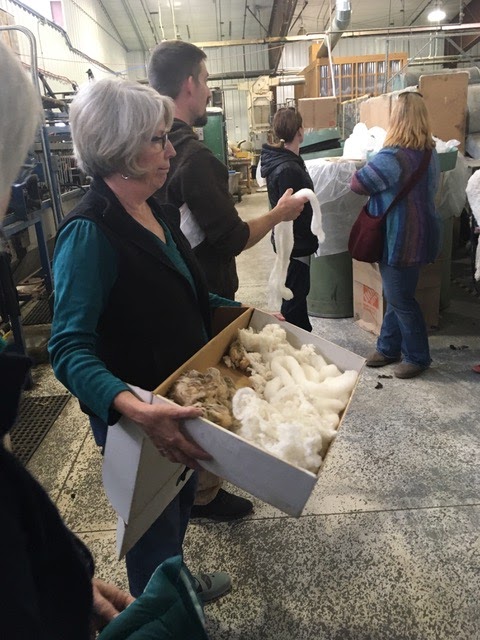
are parallel. Guild members were able to feel the
difference between the processes from the samples
shown in the box
The pin drop machines have fine combs that separate
the wool fibers. The wool is put through the process
several times. 
The wool is guided through a pin drop machine
drum carders
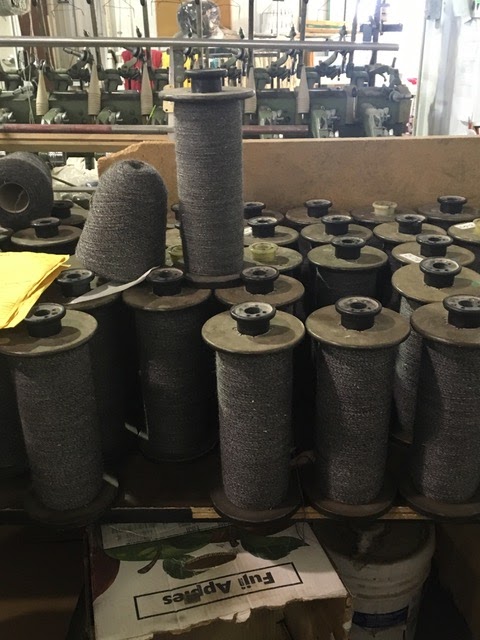
spinning the wool onto bobbins
one of the many boxes of wool being spun into yarn at the spinning machine
The spinning machine was turned on during our Saturday visit, and Ben demonstrated how quickly a broken strand could be repaired.

Large bobbins filled with yarn
Once the yarn is on the bobbin, it is skeined and then
wrapped on cones.
This machine wraps the yarn from a skein onto a cone
Some of the yarn is also dyed at the mill, and the
mill store has many gorgeous skeins for sale.
Buyers can also purchase roving from a variety of
sheep or exotic breeds. 
Finished wool items are also for sale (sweaters, hats,
mittens, throws) in the mill shop

The owners and founders of Mountain Meadow Wool share their story in the following video.


Thursday, June 29, 2017

What's the Difference?

source
Knitting Blog editor was curious the difference between yarns spun from hand carded rolags and blending board rolags. She knew that hand cards actually blend the fibers and a blending board mixes rather than thoroughly blends fiber, but she wanted to know what the yarns look like side by side.

See the results of her experiment here

Thursday, April 27, 2017

Yarn Joins

source
The Yarn Sub website offers ten methods of joining yarn.

Why know try all of the methods and find one you like best.

Tuesday, April 25, 2017

Colorful Nests

source
If you have some odd bits of yarn or fluffs of wool, why not help the birds by providing nesting material.

Please make sure the pieces aren't too long - baby bird feet can easily get tangled in long strands.

Thursday, April 20, 2017

Creating Art Yarn

source
Whether your taste is more traditional or you’re interested in creating innovative, eye-catching yarn styles, you’ll love the techniques and tips to inspire all spinning enthusiasts to unleash their creative spirit. 

In Interweave's free ebook, Spinning Novelty Yarn: Tips and Techniques for Creating Art Yarn, you’ll find a number of techniques to add to your repertoire for spinning designer yarns—or any yarns.

Thursday, April 6, 2017

Hand-combed Qiviut

musk ox
source
Interweave's article on qiviut fiber is intriguing. As one of the most luxurious and expensive fibers in the world, qiviut has sometimes been called the “golden fleece of the arctic.” It is eight times warmer than sheep’s wool and softer than almost any other fiber.

Unlike sheep, musk oxen are not sheared to harvest their fleece - experienced handlers comb the animals every spring when they’re shedding down naturally.

Read more about qiviut here

Wednesday, March 29, 2017

Working With Silk Yarn

Silk is a luscious fiber; however, it does have some unique characteristics. YarnSub's post on silk fiber and yarn explains those characteristics, some tips for using it for knitting, crochet, and also stitches and techniques that require caution when working with silk.


Tuesday, March 21, 2017

Natural Dyeing

source
Natural dyeing can be as simple as collecting tansy leaves from your garden or old tea from your cupboard, placing it and a skein of yarn in a canning jar filled with water out on your porch on a sunny day. Of course, it can be more involved as well—it depends on what colors you’re looking for, the fibers you are dyeing, and the pH levels in your water supply.

There are basic rules to dyeing: know your dye, know your fiber, and know your water.

Interweave offers a free Guide to Dyeing Yarn eBook - an essential guide whether you’re a beginner or are experienced in dyeing. 

This book will help you dive into the basics of hand dyeing yarn and understand the different approaches depending on the fiber, from cotton to wool.

Wearing Woad complied a list of Natural Dyeing Resources that may also be helpful.

Wednesday, July 20, 2016

Plant Fibers

Add caption
Twist Collective gives an excellent overview of the plant fibers of cotton, linen, and hemp and how the yarn made from these fibers is distinctive.

The article can be found here.


Wednesday, July 6, 2016

Guide to Raising Alpacas

source
Modern Farmer gives advice for those considering raising alpacas.

   •  General information
   •  Different breeds
   •  Price
   •  Life span
   •  Fiber and color

It's a good place to find some basic information on the adorable creatures with the long eyelashes.

Wednesday, June 29, 2016

From Scraps to Ribbon

source
We All Sew blog shows how to turn scraps of roving, yarn, string, ribbon, etc. into a decorative ribbon that can be used for embellishing crafts or for decorating packages and gifts.

The pictorial tutorial can be found here.

Friday, June 10, 2016

Understanding Twist Angles

source
Why would you want to measure twist? Suppose you spun a lot of yarn at one time, all the same way. You work on your project for time, then set it aside. A year or more later you come back to it, determined to finish it--but you find you don't have quite enough yarn spun. You've got the fiber, so you sit down to spin it. 

Here's another problem--you can't spin the yarn just the same because your spinning style has changed in the meantime, and the amount of twist you put in the yarn is different. You try some of the newer yarn in your project, but it looks so different from the old that it just won't work.

By measuring the twist angle of the original yarn, you can check your new yarn against that angle while you spin. That plus 'wraps per inch' will help you duplicate yarn no matter how long it's been since you spun the first one.  
(taken the HJS Studio website- link given below)

The entire article can be read on the HJS Studio website. 

Monday, May 16, 2016

Llamas and Alpacas

source
Llamas and Alpacas look similar because they are both camelids, but there are a six major differences between these two South American animals. Modern Farmer explains the differences in this brief post.  Look for more links at the bottom of that post to learn more.

Wednesday, April 20, 2016

U Design It Yarn

source
At the Guild meeting on Saturday, Vicky showed the members the yarn she designed on the U Design It Yarns website. She explained that she selected the fiber content of the yarn, the weight/twist of the yarn, and the color; thus, creating a unique yarn. Orders can be for multiple skeins, and price depends on the content and yardage of the yarn.

More information on the process can be found on the U Design It Yarns website. Note the tabs on the top of the page with helpful information.


Tuesday, April 19, 2016

Sheep Day 2016

source
The Pioneer Museum in Lander will host its annual, McDonald’s Children’s Exploration Series program, “Sheep Shearing Day” on April 23, 2016 from 1:00-3:00 pm.

This is a free day to explore the history of the sheep industry in Wind River Country. The event is open to the public and children of all ages are encouraged to attend. 

Kids can enjoy crafts, sheep wagon tours and sheep shearing. 

Laura B. demonstrates weaving at the 2015 Sheep Day
source
Guild members will be inside the museum with displays and demonstrations on cleaning wool, spinning wool, and using wool to knit, weave, and crochet. 


Monday, March 21, 2016

Using a Blending Board

Sali A. demonstrates how she uses a blending board
March 2016
After the Guild meeting on Saturday, Sali A. demonstrated how she uses a blending board to mix colors for spinning.


Once Sali had several layers of various colors, she rolled the wool on to wooden dowels, creating a tube. She then removed the dowels and the wool was ready to be spun. When spinning, Sali pulls the fiber from the center of the tube, and is always surprised at the different colors that emerge.

Sali A. rolls the fiber from the blending board onto the dowels, creating a tube.
tubes of blended fiber, yarn spun from the tube, swatches knit from the yarn
The photo above shows the tubes of blended fiber: note the white fiber on the right extending from the tube. Sali pulls the fiber out of the center of the tube as she spins. The hank and cake of yarn show the results of the blended fiber. The knit swatches reflect how the blended fiber would look in a project.

Tuesday, February 2, 2016

Valentines for Gal Pals

source
Want an inexpensive and fiber-related alternative to typical valentine cards? Simply Notable provides the answer with cardboard hearts and a bit of yarn. Click here for the full tutorial. 

The clever valentine printable and heart template are available here

source
source
Missouri Star Quilt Company coined some “punny” phrases about quilting and sewing and turned them into cute printable Valentines for you to give to all your quilty friends. The quilting and sewing themed valentines can be found here.